
Introduction
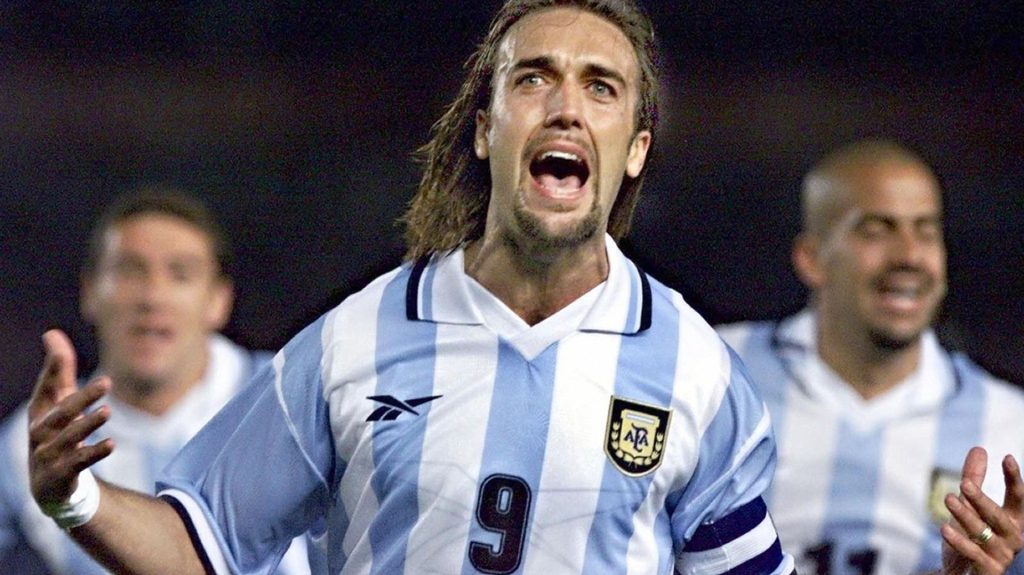
Gabriel Omar Batistuta (or Batigol) is more than just a name in football lore; he is a symbol of pure goal-scoring artistry combined with brute strength. In an era when Serie A was the global benchmark for defensive excellence, Batistuta stood out as a predator in the box, a forward who could beat the world’s best defenders with power, movement, and precision.
- Introduction
- Early Career and Development
- Dominance in Italy: Fiorentina and Beyond
- Arrival at Fiorentina
- Loyalty During Turbulent Times
- Peak Years and Goal Machines
- Silverware and Recognition
- Later Career: Roma, Inter & Qatar
- International Career: Argentina’s Predator
- Playing Style & Tactical Analysis
- Physical Power & Aerial Dominance
- Clinical Finishing
- Tactical Intelligence & Movement
- Mental Resilience and Leadership
- Statistical Impact & Records
- Legacy and Influence
- Idol in Florence
- Contribution to Argentine Football
- Tactical Prototype for Modern Number 9s
- Cultural Impact
- Evaluation & Critique
- Conclusion
This comprehensive guide explores his journey, early life, club career, international triumphs, playing style, records, and the timeless legacy he left behind.
Early Career and Development
From Reconquista to Buenos Aires
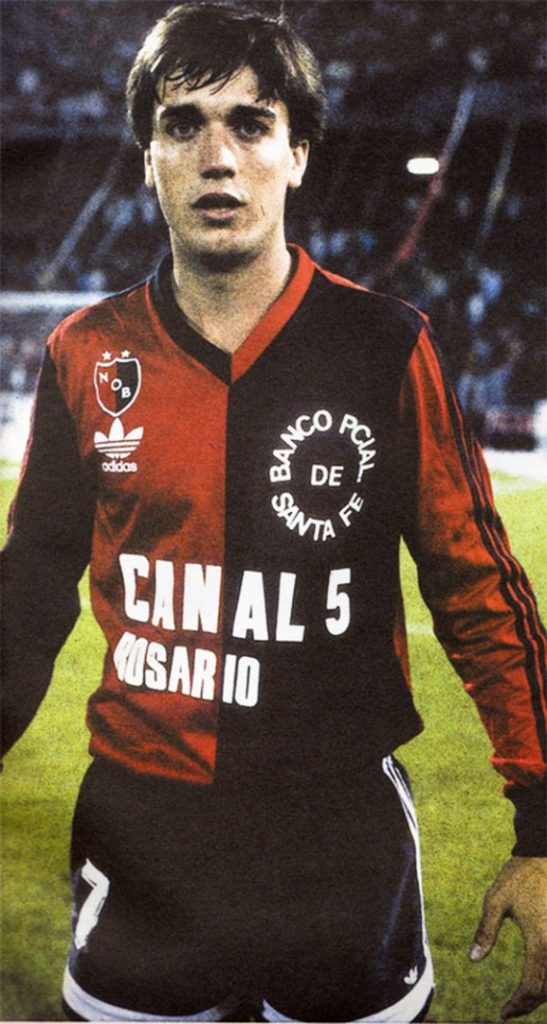
Batistuta was born in Reconquista, Argentina, in 1969. His early life was modest and unglamorous, but full of the kind of competitive spirit that breeds elite athletes. While many future footballers begin with early football obsession, Batistuta initially had a different passion, basketball. Yet, his raw athleticism quickly transferred to football, and after a successful youth tournament, he won a place in the academy of Newell’s Old Boys.
At Newell’s, his potential wasn’t immediately obvious. He was tried in various positions, sometimes as a midfielder, sometimes defensive roles, but his physical profile and natural shot power made it clear to his coaches that he belonged in the final third. This period was critical: he learned to harness his strength, refine his technique, and develop a work ethic that would define his career.
Senior Breakthrough: River Plate and Boca Juniors
Batistuta made his professional debut with Newell’s Old Boys, but soon moved to River Plate. At River, however, he struggled to impose himself. He lacked consistency, and the pressure of playing for one of Argentina’s biggest clubs exposed his inexperience.
In a bold move, he transferred to Boca Juniors, River’s city rival, in 1990. Under coach Óscar Tabárez, Batistuta’s game matured. He learned to play with his back to goal, to time his runs, and to finish with composure. During the 1990–91 season, he scored 23 league goals in 29 matches (per Britannica), a breakout performance that drew the attention of European clubs.

Dominance in Italy: Fiorentina and Beyond
Arrival at Fiorentina
In 1991, Batistuta made the leap to Serie A, signing with Fiorentina. The league he arrived in was defensively unforgiving, a proving ground for any forward. Yet, he adapted quickly. In his debut Serie A season, he scored 13 goals in 27 matches.
Loyalty During Turbulent Times
Perhaps one of the most defining moments of Batistuta’s Fiorentina career came in 1993, when the club was relegated to Serie B. Rather than leave for greener pastures, Batistuta stayed, a decision that cemented his bond with the Fiorentina faithful. His commitment was not just symbolic; he led their return to Serie A in just one season.
Peak Years and Goal Machines
Once back in the top flight, Batistuta entered the most productive phase of his career. He became the central attacking figure for Fiorentina, forming a fluid partnership with creative midfielders like Rui Costa. His goals came from all angles: blistering long-range strikes, deft finishes, and dominating headers.

According to StatMuse, in Serie A for Fiorentina, he scored 152 goals in 243 appearances and notched up 6 hat-tricks. Such consistency against elite defenses speaks to both his physical and technical mastery.
Silverware and Recognition
Despite being a goal machine, league titles largely eluded him at Fiorentina. However, he did capture key trophies: the Coppa Italia in 1996 (he was the top scorer in that tournament) and the Supercoppa Italiana in the same year. His individual brilliance was also recognized: during the 1994–95 Serie A season, he was top scorer with 26 goals.
Later Career: Roma, Inter & Qatar
AS Roma and the Scudetto
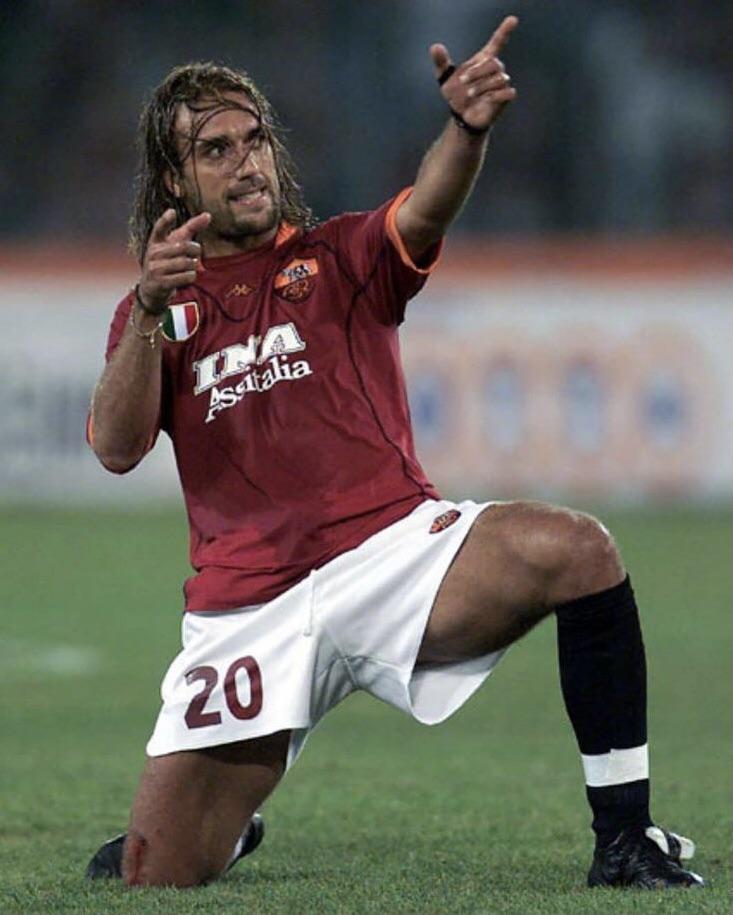
In 2000, Batistuta moved to AS Roma, in a transfer that was as much about legacy as it was about winning. With Roma, he finally achieved the one major trophy missing from his time at Fiorentina: the Serie A title in 2001. He scored 20 league goals that season in 28 appearances, a remarkable return for a forward even at his peak.
At Roma, he earned a new nickname, “El Rey Leon” (The Lion King), not just for his goal scoring but also for his leadership and presence on the pitch.
Short Spell at Inter and Final Chapter
Batistuta’s time at Roma began to taper off due to injuries. In 2003, he moved on loan to Inter Milan, where he played 12 matches but scored only 2 goals.
Seeking a final challenge, he signed for Al-Arabi SC in Qatar. In the 2003–04 season, he scored 25 goals in 18 league matches, proving he still had the instinct to find the net even in a different footballing environment. He won the league there before eventually deciding to retire.
International Career: Argentina’s Predator
Copa América and Early Impact
Batistuta made his debut with the Argentina national team in 1991. He played a key role in the squad that won Copa América that year, and repeated the feat in 1993. His strong performances in continental competition quickly made him a national hero.
World Cups and Goal Records
He represented Argentina in three FIFA World Cups (1994, 1998, 2002), scoring a total of 10 goals in those tournaments. One of the most remarkable facts about Batistuta is that he remains Argentina’s highest scorer in World Cup finals (at least for his era).
Overall, in 78 appearances for his country, he scored 56 goals. This made him Argentina’s all-time top scorer until Lionel Messi broke the record in 2016.
Related: GiGi Buffon: The Best Goalkeeper in Football History
Playing Style & Tactical Analysis
Physical Power & Aerial Dominance
Batistuta was a physical specimen: tall, muscular, and deceptively mobile. This allowed him to dominate aerial duels, particularly on set pieces and crosses. Unlike many tall forwards who rely purely on height, he combined jump timing with body strength to win headers consistently.
Clinical Finishing
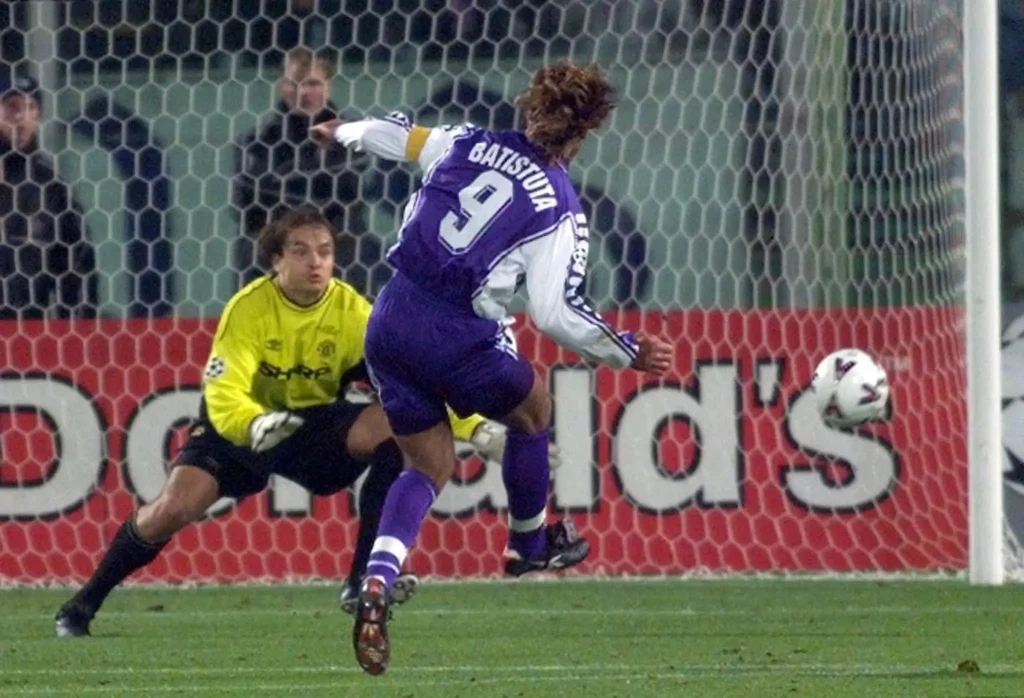
One of his defining traits was his lethal finishing. Whether with his stronger foot or the weaker one, in tight spaces or from distance, Batistuta had an uncanny ability to find the back of the net. He was also remarkably consistent: his goal-per-game ratio over multiple seasons in Serie A and in international tournaments highlights not only talent but discipline.
Tactical Intelligence & Movement
Batistuta was not just a brute; he had intelligent movement. He knew when to drop deep to link play, when to make diagonal runs behind defense, and how to position himself to receive through-balls or lay-offs. This made him more than a pure “target man”. He could play with his back to goal, connect with playmakers, and be a focal point in transitional attacks.
Mental Resilience and Leadership
His decision to stay with Fiorentina during relegation is often cited as a rare demonstration of loyalty in modern football. But beyond that, he carried a strong mentality: unafraid of big matches, committed to club goals, and capable of shouldering responsibility. At Roma, he also took on a leadership role, helping guide them to the Scudetto.
Statistical Impact & Records
- Fiorentina: 152 Serie A goals in 243 matches
- Hat-tricks: He scored 6 hat-tricks for Fiorentina in Serie A.
- Total club goals: According to his career stats, he scored around 248 goals in 444 top-level league appearances (plus other cup competitions)
- Roma: 20 goals in his first Scudetto-winning season (2000–01) in Serie A.
- International: 56 goals in 78 matches for Argentina.
- World Cup: 10 goals across three tournaments.
Legacy and Influence
Idol in Florence
Batistuta’s loyalty to Fiorentina during their darkest days earned him a godlike status in Florence. He remains a club legend, not just for his goals, but for his emotional connection to the fans. Even today, his name is chanted in the stands, and his presence looms large in Fiorentina’s modern identity.
Contribution to Argentine Football
For Argentina, Batistuta was more than a goal scorer, he was a symbol of ambition and excellence. His consistency in international tournaments, ability to shine in big matches, and role in Copa América victories cemented his place in Argentina’s pantheon of greats.
Tactical Prototype for Modern Number 9s
In many ways, Batistuta can be seen as a precursor to the modern “complete center-forward”: physically dominant, technically capable, and tactically intelligent. Many contemporary strikers (especially in European football) owe part of their on-field DNA to the template he set.
Cultural Impact
His nickname “Batigol” is iconic; he inspired youth across Argentina and Italy. Even beyond his playing career, his legacy resonates, not just because of the numbers, but because of how he played and who he was: powerful yet humble, fierce yet respectful.
Evaluation & Critique
Batistuta’s career is a case study in balancing talent with character. He was not a flashy dribbler or a tricky forward, but he was devastatingly effective. His style was pragmatic: he maximized his physical gifts, improved his movement, and adapted to different tactical systems.
A potential critique might be that Batistuta never won a Champions League, and that his trophy cabinet is not as bulging as some other legends. But this lessens neither his individual brilliance nor his impact. His legacy is rooted in consistency, loyalty, and a pure goal-scoring identity.
Conclusion
Gabriel Batistuta remains one of football’s purest and most powerful number 9s. His journey from Reconquista to the top of Serie A and international football is a blueprint for strikers who value strength, clinical finishing, and unshakeable mental resolve.
More than his goals, what defines Batistuta’s legacy is his emotion, loyalty, and professionalism. He never chased glamour for its own sake. He chased purpose, and in doing so, became a timeless icon.
In the modern game, where forwards are often judged by flashy tricks or social media popularity, Batistuta stands as a reminder: greatness can come from the sheer will to score, over and over again.